canon 7d camera manual
Canon 7D Camera Manual: A Comprehensive Guide
This guide details the Canon EOS 7D, offering PDF manuals, software instructions, and firmware updates for optimal performance. Explore features and troubleshooting tips!
The Canon EOS 7D represents a significant advancement in DSLR technology, offering a robust feature set for both amateur and professional photographers. Released in 2009, this camera quickly gained recognition for its exceptional image quality and performance. This manual serves as a comprehensive resource, guiding you through every aspect of the 7D’s capabilities.
You’ll discover detailed explanations of its controls, shooting modes, and advanced settings. Access to PDF instruction manuals and software like EOS Utility is crucial for maximizing your experience. Understanding the camera’s potential, including firmware updates, unlocks its full creative power. Whether you’re a beginner or seasoned photographer, this guide will help you master the Canon EOS 7D.
Understanding the Camera’s Key Features
The Canon EOS 7D boasts a powerful 18.0-megapixel CMOS sensor and DIGIC 4 image processor, delivering exceptional image detail and clarity. Its 8 frames-per-second continuous shooting speed is ideal for capturing fast-action sequences. A key feature is its 19-point all cross-type autofocus system, ensuring precise and reliable focusing.
The camera’s robust build quality and extensive customization options cater to professional needs. Accessing the instruction manual (available as a PDF) reveals advanced settings like Picture Style and Custom Functions. Furthermore, the 7D offers impressive video recording capabilities, enhanced by recent firmware updates, providing versatile creative control.
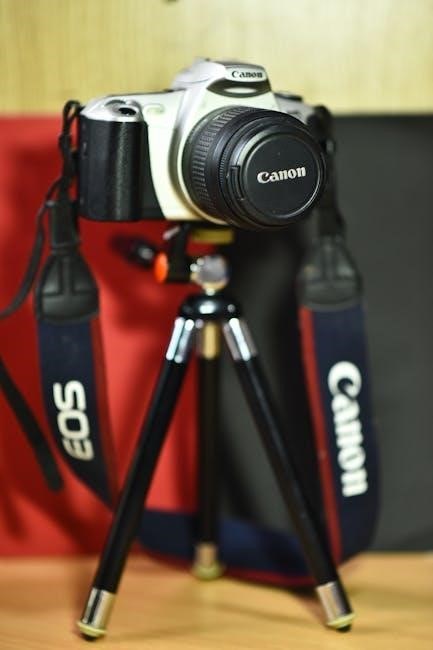
Getting Started with Your Canon 7D
Begin with the instruction manual (PDF format) for setup. Ensure proper battery charging and compatible memory card insertion for seamless operation.
Unboxing and Initial Setup
Upon receiving your Canon EOS 7D, carefully inspect the box for any damage during shipping. Inside, you’ll find the camera body, battery, battery charger, power cable, and various manuals – including the comprehensive instruction manual in PDF format on the included CD-ROM.
Before powering on, insert a compatible memory card. The manual details supported card types. Connect the battery charger and fully charge the battery before initial use. Follow the instruction manual’s guidance to properly install the battery and familiarize yourself with the camera’s basic layout. Initial setup involves setting the date, time, and preferred language, all explained within the provided documentation.
Battery and Charging Information
The Canon EOS 7D utilizes a specific battery pack; refer to your instruction manual for the exact model number. Always use the supplied battery charger to ensure proper charging and prevent damage. Initial charging may take several hours – the manual details indicator lights signifying charge status.
Avoid using third-party chargers as they may not provide the correct voltage. The PDF manual outlines safe battery handling procedures, including storage temperatures and disposal guidelines. Battery life varies depending on usage; conserve power by utilizing the camera’s power-saving features, as described in the comprehensive guide.
Memory Card Compatibility and Usage
The Canon EOS 7D supports CompactFlash (CF) memory cards. Consult the instruction manual for a list of tested and recommended CF cards for optimal performance. Ensure the card’s write-protect switch is disengaged before attempting to save images. Formatting the card in-camera is recommended for best compatibility.
The PDF manual details how to access card management options within the menu system. Regularly back up your images to a computer or external storage device. Avoid removing the card during data transfer to prevent corruption. Refer to the manual for troubleshooting card-related errors.
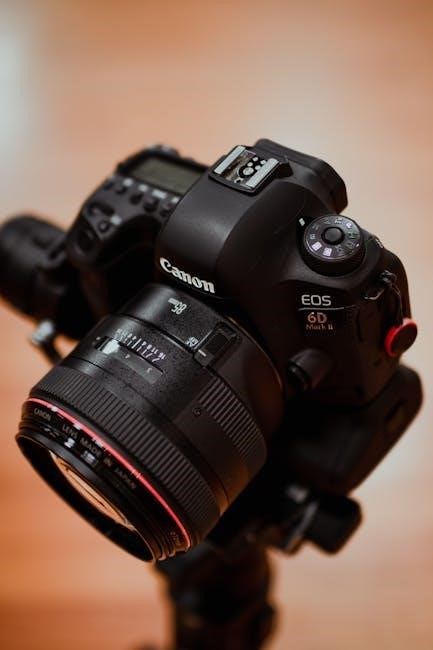
Basic Camera Operations
Learn to power the Canon 7D on/off, navigate its menu system, and utilize the Quick Control Screen for efficient settings adjustments, as detailed in the manual.
Powering On/Off and Mode Dial
The Canon 7D’s power switch resides around the shutter button; move it to the right for operation. To conserve battery, the camera automatically powers off after inactivity. The mode dial, located on top, is central to operation.
Positions include automatic modes, Program AE (P), Aperture Priority (Av), Shutter Priority (Tv), and Manual (M). Familiarize yourself with each mode’s function, as explained in the instruction manual.
Customizing the dial is possible via Custom Functions. Understanding these settings unlocks creative control. The manual provides detailed diagrams and explanations for each mode and dial function, ensuring optimal usage and photographic results.
Navigating the Menu System
The Canon 7D’s menu system, accessed via the ‘MENU’ button, is logically organized into tabs: Shooting, AF, Setup, Custom Functions, and My Menu. Use the directional buttons to navigate and the ‘SET’ button to select options.
EOS Utility software, detailed in the instruction manual, aids in understanding menu options. The PDF manual provides a comprehensive overview of each setting. Custom Functions allow personalization, tailoring the camera to your shooting style.
Mastering the menu is crucial for unlocking the 7D’s full potential. Refer to the manual for detailed explanations and diagrams, ensuring efficient operation and optimal image quality.
Understanding the Quick Control Screen
The Quick Control Screen, activated by the ‘Q’ button, provides rapid access to frequently used settings like shooting mode, ISO, white balance, and autofocus. It’s a streamlined interface for on-the-fly adjustments.
Refer to the Canon 7D’s instruction manual (PDF format) for a detailed breakdown of each setting displayed. Use the rear dial to change values and the ‘SET’ button to confirm. This screen minimizes menu diving during shooting.
EOS Utility software complements the Quick Control Screen, offering further customization. Mastering this feature enhances shooting efficiency and responsiveness, crucial for capturing fleeting moments.
Shooting Modes Explained
Explore automatic, Program AE, aperture priority, shutter priority, and manual modes within the Canon 7D. The instruction manual details each mode’s function!
Automatic Shooting Modes
The Canon EOS 7D offers several automatic shooting modes designed for simplicity and convenience, perfect for beginners or quick snapshots. These modes allow the camera to handle most settings, optimizing for common scenarios. The instruction manual details each option, including the fully automatic mode where the camera selects everything from aperture and shutter speed to ISO and white balance.
Scene modes, also considered automatic, provide pre-configured settings for specific situations like portrait, landscape, sports, and macro photography. These intelligently adjust camera parameters to achieve optimal results for each scene. Understanding these modes, as outlined in the manual, empowers users to capture quality images without extensive technical knowledge, making the 7D accessible to all skill levels.
Program AE (P) Mode
Program AE (P) mode on the Canon EOS 7D offers a balance between automatic operation and creative control. The camera sets both aperture and shutter speed, but allows the photographer to adjust ISO, white balance, and exposure compensation. This mode is ideal when you want the camera to handle the technical aspects while still retaining some influence over the final image.
The instruction manual explains how to utilize Program Shift, a feature within P mode that lets you cycle through equivalent aperture and shutter speed combinations while maintaining the same exposure. This provides a degree of artistic control without fully transitioning to Aperture Priority or Shutter Priority modes. It’s a versatile option for various shooting situations.
Aperture Priority (Av) Mode
Aperture Priority (Av) mode on the Canon EOS 7D empowers photographers to control the depth of field. You select the desired aperture (f-stop), and the camera automatically determines the appropriate shutter speed for correct exposure. This is crucial for controlling background blur (bokeh) or ensuring sharpness throughout the image.
The camera manual details how Av mode is excellent for portraiture, landscapes, and situations where depth of field is paramount. Remember to monitor the shutter speed to avoid motion blur, especially in low light; Exposure compensation remains available for fine-tuning the brightness of your images within this mode, offering creative flexibility.
Shutter Priority (Tv) Mode
Shutter Priority (Tv) mode on the Canon 7D allows you to dictate the shutter speed, while the camera calculates the corresponding aperture for proper exposure; This mode is ideal for capturing motion – either freezing fast action with a quick shutter speed or blurring movement for a dynamic effect.
The camera manual highlights its usefulness in sports photography or creating silky-smooth water effects. Be mindful that the aperture chosen by the camera impacts depth of field. Utilize exposure compensation to adjust brightness if needed. Understanding the interplay between shutter speed, aperture, and ISO is key to mastering Tv mode and achieving your desired results.
Manual (M) Mode
Manual (M) mode grants you complete creative control over both shutter speed and aperture on your Canon 7D. This mode, detailed in the camera manual, requires a thorough understanding of exposure principles. You independently set both values, and the camera displays exposure indicators to guide you.
It’s perfect for challenging lighting situations or when you desire a specific look. Mastering M mode allows for consistent results and artistic expression. Remember to monitor the light meter and adjust settings accordingly. Utilizing the quick control screen simplifies adjustments while shooting. Experimentation is key to unlocking the full potential of this powerful mode!
Focusing and Exposure
Explore autofocus modes, focus point selection, exposure compensation, and metering modes within the Canon 7D manual for precise image control and quality.
Autofocus Modes and Selection
The Canon EOS 7D offers a versatile range of autofocus (AF) modes to suit diverse shooting scenarios. Understanding these modes, detailed within the camera’s instruction manual, is crucial for achieving sharp, focused images.
One-Shot AF is ideal for stationary subjects, locking focus when the shutter button is half-pressed. AI Servo AF continuously tracks moving subjects, maintaining focus as they change position. AI Focus AF intelligently switches between One-Shot and AI Servo, attempting to determine the subject’s movement.
Selecting the appropriate AF mode is vital. The manual explains how to customize AF behavior, including AF point expansion and tracking sensitivity, allowing photographers to fine-tune the system for their specific needs and creative vision. Proper AF mode selection ensures consistently sharp results.
Focus Point Selection
The Canon EOS 7D provides extensive control over focus point selection, detailed in the comprehensive instruction manual. You can choose from 19 AF points, allowing precise targeting of your subject. Selection modes include automatic selection, spot AF for pinpoint accuracy, and manual selection for complete control.
Manual selection lets you directly choose the active AF point using the directional buttons. AF point expansion offers a wider focusing area around your chosen point, useful for moving subjects. The manual explains how to customize AF point behavior, including remembering focus points for specific lenses.
Mastering focus point selection is key to consistently sharp images, ensuring your intended subject is perfectly in focus, regardless of composition or movement.
Exposure Compensation
The Canon EOS 7D’s exposure compensation feature, thoroughly explained in the instruction manual, allows you to fine-tune the camera’s automatic exposure settings. This is crucial when the camera’s meter is fooled by bright or dark scenes, resulting in under or overexposed images.
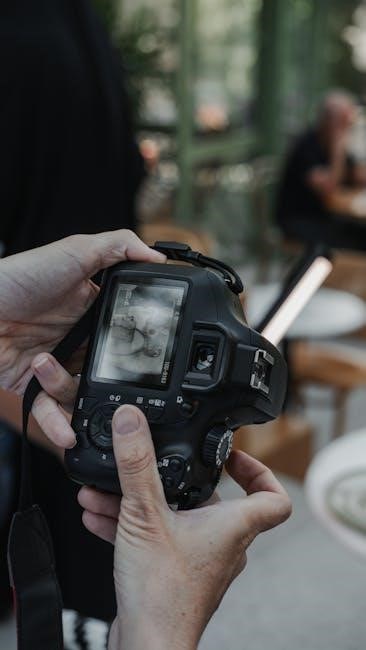
Exposure compensation is adjusted in plus or minus EV (Exposure Value) steps. Increasing the EV brightens the image, while decreasing it darkens it. The manual details how to access and adjust this setting quickly via the Quick Control Screen.
Understanding exposure compensation empowers you to achieve accurate exposures in challenging lighting conditions, ensuring your photos reflect your artistic vision.
Metering Modes
The Canon EOS 7D offers several metering modes, detailed in the comprehensive instruction manual, to analyze scene brightness and determine optimal exposure. Evaluative metering, the default, assesses the entire scene for balanced exposure. Partial metering focuses on a smaller area, useful for backlit subjects.
Spot metering measures light from a very small point, ideal for precise exposure control. Center-weighted average metering prioritizes the center of the frame. The manual explains when to utilize each mode for best results.
Selecting the correct metering mode is vital for achieving properly exposed images in diverse shooting scenarios.

Advanced Features and Settings
Explore custom functions, picture style settings, white balance, and video recording options within the Canon 7D’s detailed instruction manual.
Custom Functions and Personalization
The Canon EOS 7D offers extensive customization through its custom function settings. These allow photographers to tailor the camera’s operation to their specific shooting style and preferences. The instruction manual details each function, explaining how to modify button assignments, menu display, and various operational behaviors.
Personalization extends to autofocus settings, image quality parameters, and display options. Users can create and save personalized setups for different shooting scenarios, streamlining workflow and enhancing efficiency. Mastering these custom functions unlocks the full potential of the 7D, enabling photographers to achieve precise control and creative expression. Refer to the PDF manual for a comprehensive list and detailed explanations.
Picture Style Settings
Canon’s Picture Style settings are pre-defined image processing parameters that influence the look of your photographs directly in-camera. The EOS 7D offers several presets – Standard, Portrait, Landscape, Neutral, Faithful, and Monochrome – each designed for specific subjects and artistic intentions.
These styles adjust sharpness, contrast, color saturation, and tone. Users can further refine these presets or create entirely custom Picture Styles using the camera’s menu system. The instruction manual provides detailed guidance on adjusting each parameter. Understanding and utilizing Picture Styles allows photographers to achieve desired results without extensive post-processing, enhancing creative control. Explore the PDF manual for in-depth explanations.
White Balance Adjustment
White balance (WB) ensures accurate color rendition under varying light sources. The Canon EOS 7D offers numerous WB presets – Auto, Daylight, Cloudy, Shade, Tungsten, Fluorescent, Flash, and Custom. Auto WB generally performs well, but specific presets or custom settings are crucial for challenging conditions.
Custom WB allows you to manually set the color temperature using a white or gray card for precise results. The instruction manual details how to navigate the WB menu and fine-tune settings. Incorrect WB leads to color casts; mastering this feature, as detailed in the PDF, is vital for professional-looking images. Experiment to achieve natural and accurate colors.
Video Recording Capabilities
The Canon EOS 7D records high-definition video at 720p and 1080p resolutions, offering a significant feature for its time. The manual details various recording settings, including frame rates (24fps, 30fps) and video quality options. Notably, a firmware update brought manual audio level control, aligning it with other Canon DSLRs.
Understanding the limitations – like recording time – is crucial, as outlined in the instruction manual. The PDF guide explains how to connect external microphones for improved audio. While not a modern cinema camera, the 7D’s video capabilities, when mastered, deliver impressive results.
Connectivity and Software
Canon provides EOS Utility software, alongside instruction manuals (PDF format), for computer connection and firmware updates. Access these resources online!
Connecting to a Computer
Establishing a connection between your Canon EOS 7D and a computer allows for image transfer, remote control capabilities, and software updates. Typically, this is achieved using a USB cable, included with the camera or available separately. Ensure the camera is powered off before connecting.
Once connected, your computer should recognize the 7D as a storage device, enabling you to directly copy images. Alternatively, utilize the EOS Utility software – downloadable from Canon’s website – for more advanced functionalities. This software facilitates image organization, remote live view control, and camera settings adjustments directly from your computer.
Refer to the instruction manual (available as a PDF) for detailed step-by-step instructions and troubleshooting tips regarding connectivity issues.
EOS Utility Software Overview
EOS Utility, downloadable from Canon’s official website, is a powerful software suite designed to enhance your Canon EOS 7D experience. It offers a range of features beyond simple image transfer, including remote live view control, allowing you to compose and trigger shots directly from your computer.
The software facilitates image browsing, selection, and downloading, with options for renaming and organizing files. EOS Utility also enables remote camera settings adjustments, providing precise control over aperture, shutter speed, and ISO.
Detailed instruction manuals, often available as PDF files alongside the software, guide you through each function. It’s essential for maximizing the 7D’s potential.
Firmware Updates and Installation
Firmware updates are crucial for maintaining optimal Canon EOS 7D performance and unlocking new features. Canon regularly releases updates addressing bugs and enhancing functionality, like the 7D v2 firmware offering improved audio control.
Download the latest firmware from Canon’s official website, ensuring it’s specifically for your 7D model. Carefully follow the instruction manual – often a PDF – detailing the installation process.
Typically, this involves transferring the firmware file to a memory card, inserting the card into the camera, and initiating the update through the camera’s menu. Do not interrupt the process to avoid damaging the camera.
Troubleshooting Common Issues
Resolve error messages, image quality problems, and connectivity issues using the Canon 7D’s manual and online resources for a smooth shooting experience.
Error Messages and Solutions
Encountering error messages on your Canon EOS 7D can be frustrating, but often easily resolved. The camera’s manual provides a comprehensive list of codes and their meanings. Common errors include card errors (check compatibility and formatting), lens communication issues (ensure proper connection), and internal camera errors (try resetting the camera to factory defaults).
If an error persists, consult Canon’s official website for detailed troubleshooting guides and PDF downloads. Online forums and communities also offer valuable insights from experienced users who may have encountered similar problems. Remember to note the exact error code displayed for accurate diagnosis and solution finding. A firmware update might also address certain error occurrences.
Image Quality Problems
Addressing image quality issues on your Canon 7D requires systematic troubleshooting. Soft or blurry images often indicate incorrect focusing or slow shutter speeds. Noise, particularly in low light, can be minimized by adjusting ISO settings and utilizing noise reduction features within the camera or post-processing software.
Color inaccuracies might stem from improper white balance settings; experiment with presets or custom settings. Refer to the manual for Picture Style adjustments to fine-tune color rendition. Check lens cleanliness and consider calibration. PDF guides on Canon’s website offer detailed advice on optimizing image quality.
Connectivity Issues
Experiencing connectivity problems with your Canon 7D? Ensure the correct USB cable is used and securely connected to both the camera and computer. Verify that EOS Utility software is properly installed and updated – the instruction manual (available as a PDF) details installation steps.
If issues persist, check device recognition in your computer’s device manager. Firewalls or security software might interfere; temporarily disable them for testing. Firmware updates, downloadable from Canon’s official website, often resolve compatibility issues. Consult online forums for community solutions to specific connectivity challenges.
Resources and Support
Access Canon’s official website for manual downloads, PDF guides, and EOS Utility software. Explore online forums and communities for peer support and warranty details.
Canon’s Official Website and Manual Downloads
Canon’s official website serves as a central hub for all EOS 7D resources. Users can directly download the comprehensive camera manual in PDF format, ensuring they have readily available guidance at their fingertips.
Furthermore, the site provides access to the latest firmware updates, crucial for maintaining optimal camera performance and addressing potential issues. Software downloads, including EOS Utility, are also available, facilitating seamless image transfer and remote control capabilities.
Canon also offers detailed instruction manuals for software like EOS Utility, ensuring users can fully leverage its features. The website’s dedicated support section provides troubleshooting assistance and answers to frequently asked questions, enhancing the overall user experience.
Online Forums and Communities
Canon 7D users benefit greatly from vibrant online forums and communities dedicated to photography and this specific camera model. These platforms offer a space to connect with fellow enthusiasts, share experiences, and seek advice on mastering the camera’s features.
Discussions range from troubleshooting common issues and understanding complex settings to sharing stunning photographs and creative techniques. Users often post helpful tips, tutorials, and insights gleaned from studying the instruction manual and experimenting with the camera.
These communities provide a valuable resource for learning beyond the PDF manual, fostering a collaborative environment where Canon 7D owners can enhance their skills and passion for photography.
Warranty Information
Canon provides a standard warranty for the EOS 7D camera, protecting against manufacturing defects in materials and workmanship. The duration and specific terms of the warranty can vary depending on the region of purchase, so it’s crucial to review the documentation included with your camera.
Typically, the warranty covers repairs or replacements during a defined period from the original purchase date. It’s important to register your Canon 7D to ensure seamless warranty service. Keep your proof of purchase – the original receipt – readily available.
Refer to Canon’s official website for detailed warranty information, including exclusions and procedures for claiming warranty service. Understanding these details safeguards your investment.